
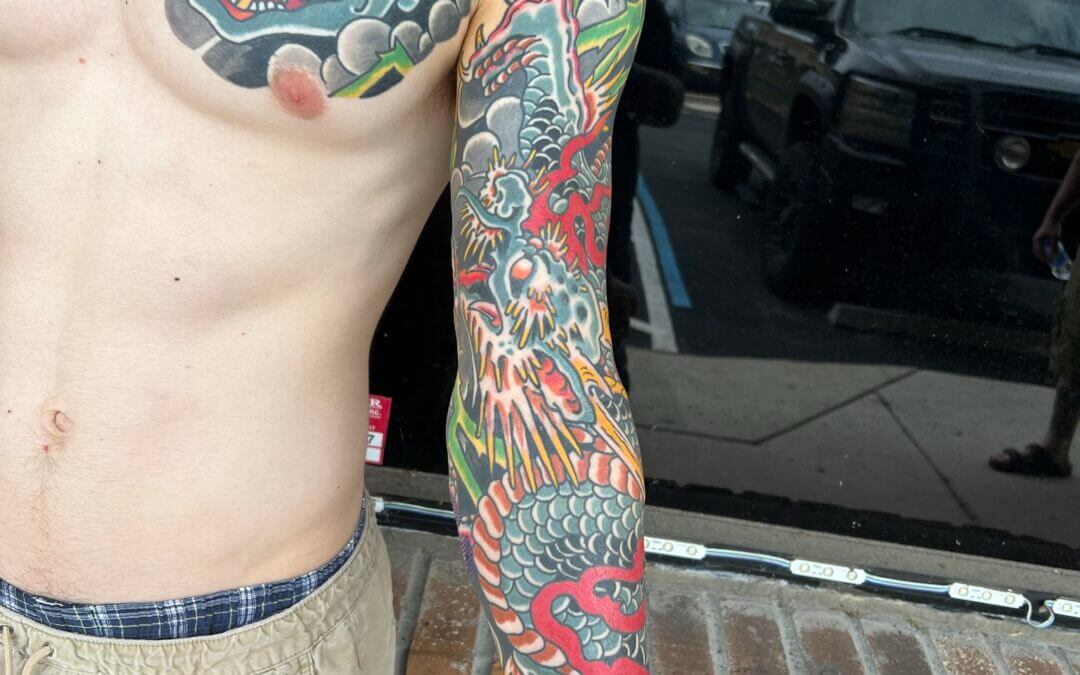
The koi fish is one of the most meaningful tattoos you can get. Every color, every swimming direction, every pairing tells a different story. If you’re considering a koi — alone or as part of a Japanese sleeve — here’s everything the traditional symbolism tells us.
The Legend Behind Koi Tattoos
Chinese and Japanese legend says a koi that swims up a great waterfall — against a relentless current — transforms into a dragon when it reaches the top. That story is the heart of every koi tattoo: perseverance, determination, and overcoming struggle.
If life has put you through something hard and you came out the other side, a koi is a natural fit.
Swimming Direction
- Upstream (swimming up): you’re still in the fight. Ongoing struggle, continuing effort.
- Downstream (swimming down): the battle is won. Sometimes shown with falling leaves or post-waterfall imagery.
Both are legitimate — neither is “better.” Pick based on where you are in your story.
Color Meanings
- Black koi (karasu): overcoming hardship, masculinity. Often represents the father figure in koi family imagery.
- Red koi (higoi): love, strength, passion. Traditionally represents the mother or matriarch.
- Gold/yellow koi (yamabuki): wealth, prosperity, good fortune.
- Blue koi: masculinity, peace, tranquility. Typically represents a son.
- Pink koi: femininity, traditionally a daughter.
- White koi: success in career, purity.
- Calico koi (multi-color): transformation, change.
Pairings and Compositions
Koi are rarely tattooed in isolation. Classical Japanese compositions pair them with:
- Waterfalls — the struggle
- Lotus flowers — enlightenment, spiritual growth
- Cherry blossoms — impermanence, beauty
- Dragons — the koi’s transformed form
- Other koi — family, yin-yang balance
Placement
Koi work beautifully on:
- Sleeves — flowing with the muscle, often swimming up or down the arm
- Back pieces — single large koi with waves and waterfall
- Thighs — great canvas for a large koi with background
- Calves — the upward motion reads well
Design Mistakes to Avoid
- Skipping the background — a floating koi with no waves or waterfall looks unfinished by Japanese tradition.
- Mismatched color direction — a black koi swimming with a pink koi (father + daughter) tells a specific family story; know the story you’re telling.
- Too small for detail — koi scales benefit from real size.
Book a Consultation at Idle Hands Tattoo Co.
If you’re in Jacksonville, St. Johns County, the beaches, or anywhere in Northeast Florida and you want to talk about a new piece, reach out. Idle Hands Tattoo Co. is Jeff Jibran’s private studio specializing in Japanese, American traditional, and black & grey work.
Call (904) 647-5183 or visit us at 3938 Sunbeam Road #4, Jacksonville, FL 32257. Monday–Saturday, 12:30 PM – 7:00 PM. Consultations are always free.
Recent Comments